Few names in the history of comic art command the same reverence as Jean Giraud, a Frenchman whose pencil and brush gave shape to entire universes. Working under his own name and under the celebrated pseudonym Moebius, he built a body of work that stretched from dusty American frontiers to hallucinatory alien worlds, and in doing so he changed what a comic page could look like.
Key points
- Jean Giraud maintained a dual creative identity, using the name 'Gir' for classical realism and 'Moebius' for surrealist science fiction.
- His early training under Jijé and a formative period spent in Mexico heavily influenced the grounded, detailed Western aesthetic of his Blueberry series.
- Giraud helped revolutionize European comics by co-founding Les Humanoïdes Associés and the influential magazine Métal Hurlant.
- His artistic mastery was defined by an exceptional technical range, shifting fluidly between different mediums like ink, watercolor, and digital tools.
- Works like 'The Airtight Garage' and 'The Incal' showcased his ability to blend organic architectural designs with complex, dreamlike compositions.
- Giraud's influence extended far beyond comics, significantly shaping the visual language of science fiction cinema through his concept art for films like Alien and Blade Runner.
- His unique fusion of Franco-Belgian traditions with avant-garde imagery left a lasting legacy that continues to inspire manga artists, filmmakers, and contemporary graphic novelists.
Giraud's dual identity: blueberry and moebius
Born on 8 May 1938 in Nogent-sur-Marne, just outside Paris, Giraud discovered American comics as a boy and never quite let go of that early fascination. He made his debut at eighteen in Far West magazine, and his time spent living in Mexico left a lasting imprint on his visual imagination, feeding directly into the dusty landscapes and weathered faces that would later populate his Western strips. He trained under the celebrated Belgian artist Joseph Gillain, known as Jijé, an apprenticeship that sharpened his classical draughtsmanship considerably.
The western aesthetic of lieutenant blueberry
It was under the name Gir that Giraud produced his most classically rendered work, and nothing embodies this better than the Blueberry series, launched on 31 October 1963. The adventures of the cynical cavalry officer became an instant touchstone for the Western genre in bandes dessinées, drawing comparisons to painters such as Frederic Remington in the way horses, dust and gunfights were rendered with such physical conviction. This was Giraud working in his more grounded, classical register, proving that meticulous realism could carry as much emotional weight as any experimental flourish.
Moebius: exploring science fiction and surrealism
By 1963, Giraud had also begun signing surreal, loosely constructed stories as Moebius, clearly inspired by the anarchic humour of the American magazine MAD. The upheaval of the 1968 protests split the comics world between traditionalists and those hungry for something stranger, and Giraud found himself drawn towards the latter camp. This avant-garde persona flourished further after he co-founded Les Humanoïdes Associés in 1974, a publishing venture that became a home for boundary-pushing European comics and gave rise to the legendary magazine Métal Hurlant, where stories such as Arzach and The Airtight Garage first appeared.
Signature techniques and visual language
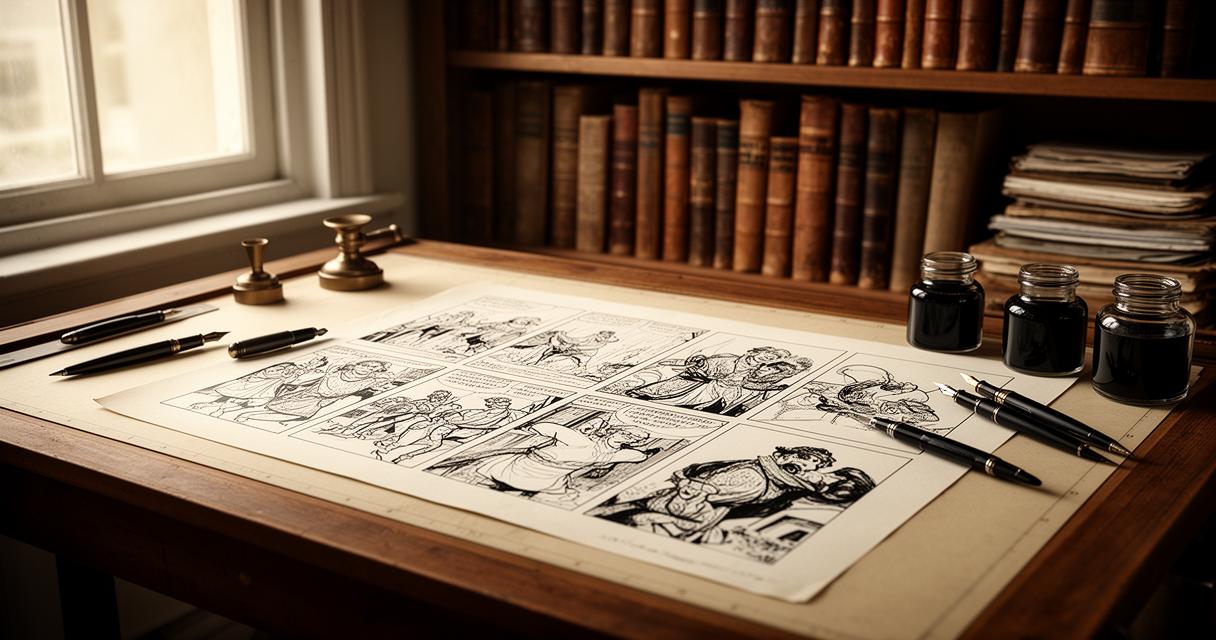
What set Giraud apart was not simply imagination but sheer technical command. He moved fluently between pen and ink, watercolour, gouache and, later in his career, digital colour, adapting his tools to whatever mood a story demanded.
Linework and Composition in The Airtight Garage
The cartoonist Sergio Aragonés once remarked that everything in a Giraud drawing has a function, and that observation captures the essence of his approach to composition. His pen work could shift from sparse, almost minimal lines to densely textured, labyrinthine detail, yet he always found what admirers describe as the perfect line weight for his subject matter. This mastery of linework is nowhere more evident than in The Airtight Garage, a sprawling, dreamlike narrative that became a proving ground for his most experimental compositional ideas, filled with architecture that seemed to breathe and machinery that felt organic.
Colour palettes and atmospheric storytelling
Giraud understood colour as a storytelling device rather than mere decoration, using washes of watercolour and gouache to build atmosphere long before digital tools became available to him. This sensitivity to mood extended beyond the printed page. He was invited to design an entire floor at the Metreon entertainment complex in San Francisco, where each level had been handed to a different artist to reimagine. Giraud chose his own paint colours, designed intricate bas-reliefs and even created video games for an arcade on his floor, fittingly named the Airtight Garage after his own comic. Sony was reportedly so pleased with the result that they gifted him an original Frederic Remington painting, a fitting nod to the Western influences that had shaped his early Gir work. That floor no longer exists today, but photographs and recollections of it remain treasured among fans who managed to visit before it closed.
Enduring influence on contemporary graphic narratives
Giraud's reach extended well beyond the page, touching cinema, video games and the wider language of visual storytelling across continents.
Cross-cultural impact: from franco-belgian bandes dessinées to manga
His fusion of Franco-Belgian tradition with wildly inventive, almost psychedelic imagery helped bridge European comics with American and Japanese traditions alike, influencing manga artists who admired his fluid linework and imaginative world-building. The Incal, his landmark collaboration with Alejandro Jodorowsky published between 1981 and 1988, remains a touchstone of science fiction storytelling, its surreal stories and richly imagined societies still studied by artists today. Giraud's talents were equally valued in cinema, where he provided concept art for films including Alien and Blade Runner, shaping the visual grammar of science fiction cinema for decades afterwards.
Legacy among modern comic artists and filmmakers
Even collaborations with American comics giants demonstrated his versatility, most notably his 1988 work with Stan Lee on the Silver Surfer story Parabola. Today, readers and collectors continue to discuss and seek out compilations of his art, keen to revisit the strange, beautiful worlds he built. His influence lingers across traditional comics and modern comics alike, in concept art studios, in video games, and in the imaginations of countless artists who first encountered his work as wide-eyed teenagers. Few creators have managed to move so effortlessly between classical style and radical experimentation, and it is this duality, embodied in the names Gir and Moebius, that ensures Jean Giraud's place among the most significant figures in the entire history of graphic storytelling.